
Children and teens
Primary anterior crossbite treatment | Preortho Type 3 case at age 5
Children and teens · MIND Orthodontic Clinic
When primary front teeth bite in reverse, jaw movement also needs assessment
Hello from Mind Orthodontic Clinic in Ansan.
If your child's lower front teeth sit ahead of the upper front teeth, you may wonder whether to wait until the permanent teeth come in. It is important to examine not only the bite but also whether the lower jaw slides forward when the mouth closes. This is because premature tooth contact can cause a functional anterior crossbite in which the child pushes the jaw forward to bite.
Today, we introduce the progress of a child who visited with anterior crossbite in the primary dentition and was treated with Preortho Type 3.
Key points of this article
- This patient had a functional anterior crossbite in which the front teeth caught, making the child push the lower jaw forward to bite.
- Preortho Type 3 was worn for about 10 hours daily, and the anterior crossbite improved about a month after wear began.
- We are currently monitoring whether crossbite develops as the remaining permanent teeth erupt.
Clinical case | A child whose lower jaw moved forward when the front teeth caught
- Age
- Age 5
- Treatment Duration
- 2 months (2026.08.01 ~ 2026.10.16)
- Appliance
- Preortho Type 3
- Treatment Method
- Removable appliance wear · About 10 hours daily
Condition at the initial visit
This patient visited with a primary anterior crossbite. The problem was not simply that the lower front teeth were ahead. As the mouth closed, the front teeth caught, and the lower jaw slid forward along that contact.
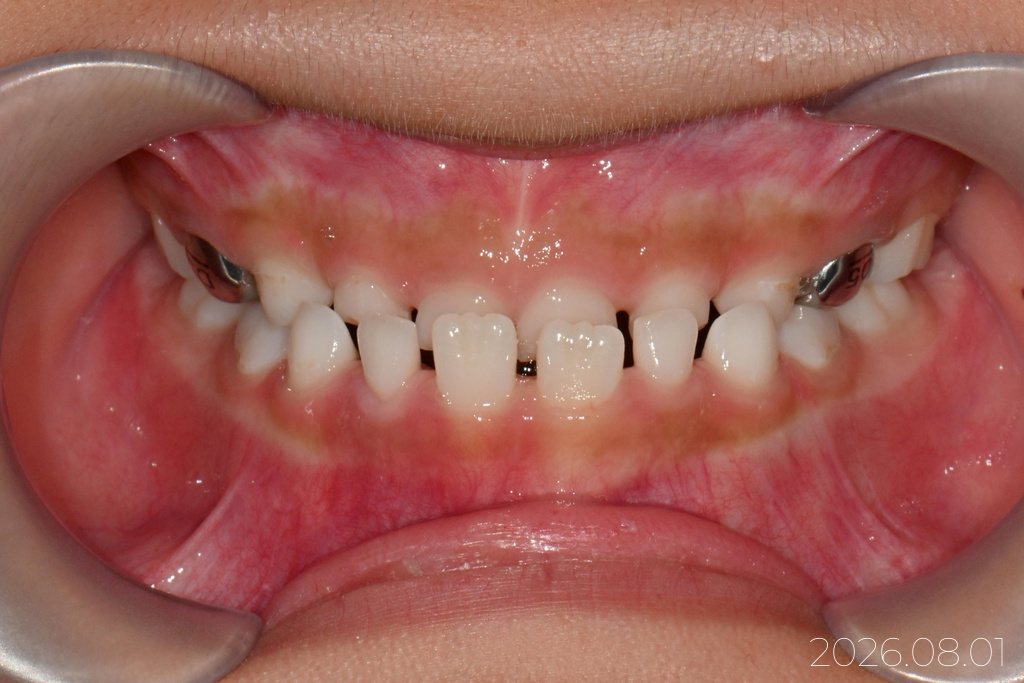
Considering this functional movement, we decided to use Preortho Type 3. Treatment aimed both to improve the anterior bite and to change the situation causing the child to push the jaw forward to bite.
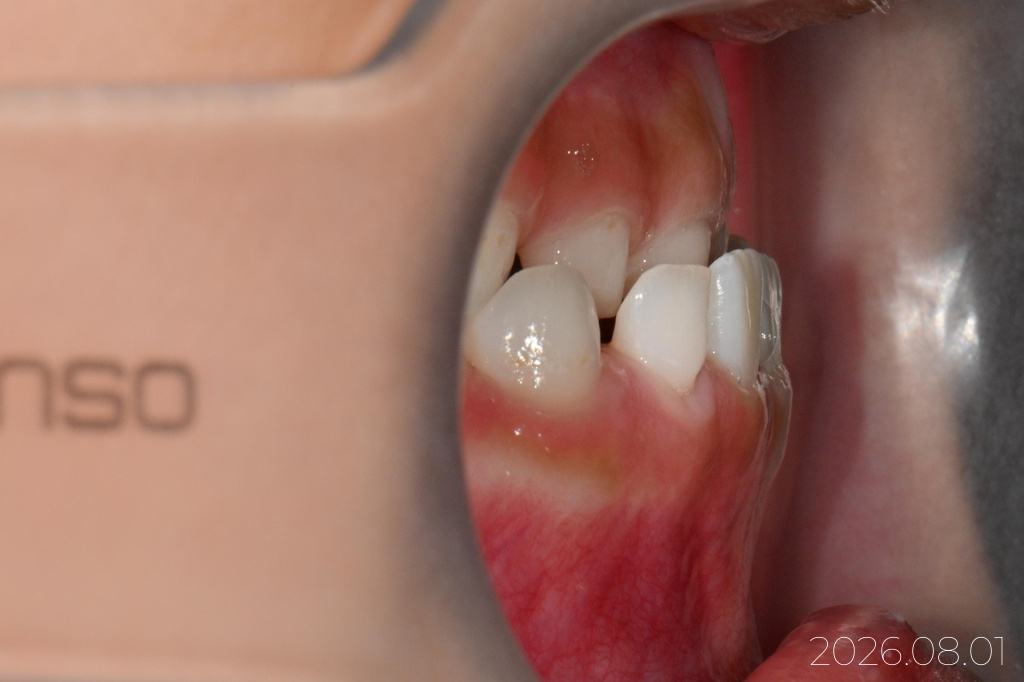
Anterior crossbite improved about a month after appliance wear began
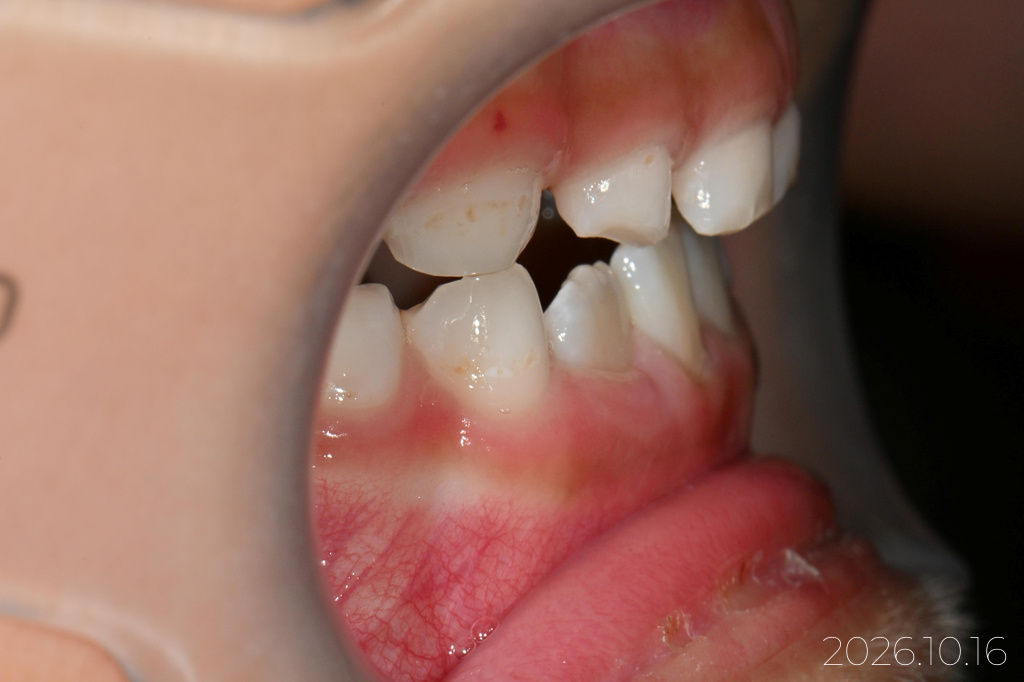
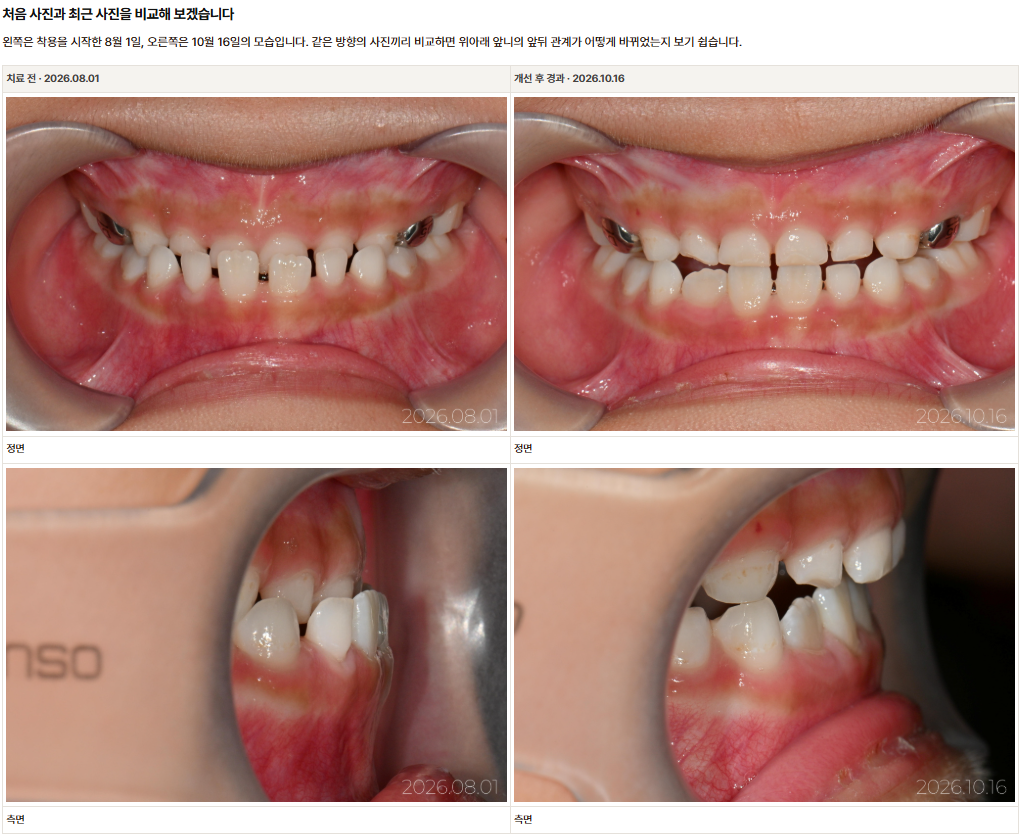
Appliance wear began on August 1, 2026, for about 10 hours daily. The anterior crossbite first improved after about a month.
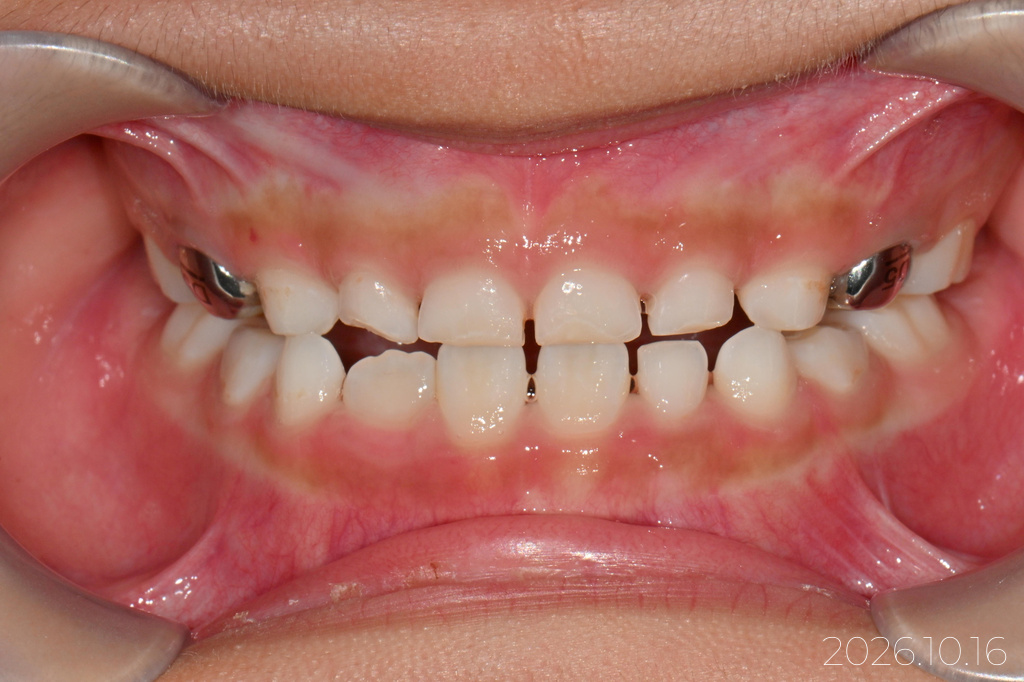
With removable appliances, actual wear time is important during treatment. This child showed relatively rapid changes with about 10 hours of daily wear.
We are currently monitoring whether crossbite develops as the remaining permanent teeth erupt. The October 16 photographs therefore document follow-up after improvement, rather than completion of all orthodontic treatment.
What kind of orthodontic appliance is Preortho?
Preortho is a flexible, prefabricated functional orthodontic appliance that children can insert and remove themselves.
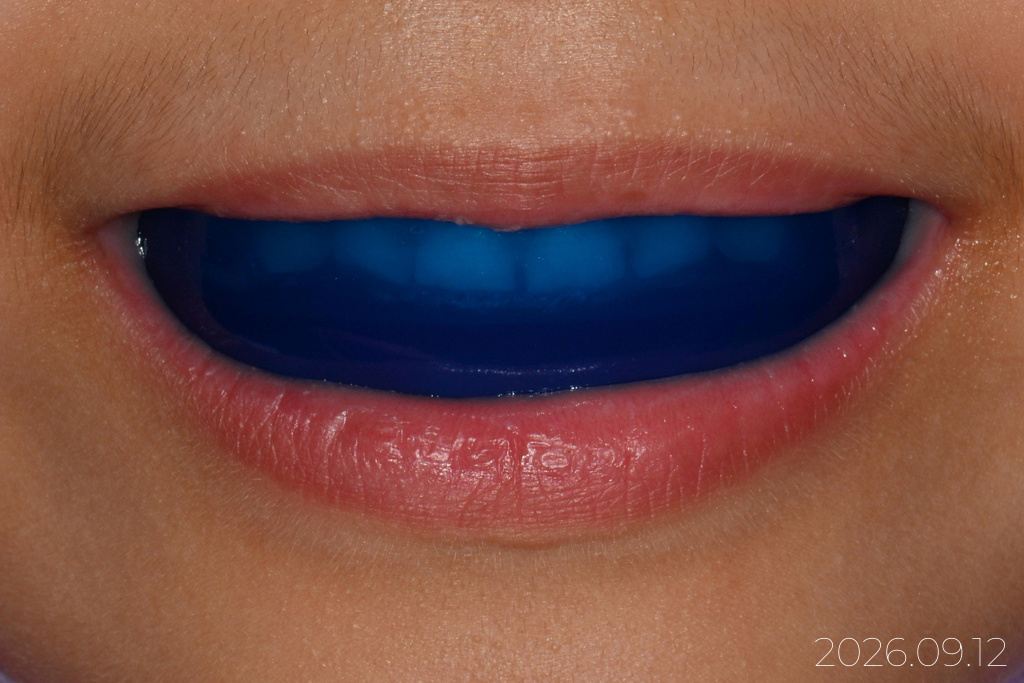
Its tooth-bearing sections and the parts in contact with the tongue, lips, and cheeks are designed to influence tooth position and oral muscle function.
It is used differently from fixed orthodontic treatment, where appliances are attached to individual teeth, or clear aligners, which involve individually planned stages of tooth movement. An appliance suited to the child's mouth is selected from available shapes and sizes, and used while checking its fit and the response. Preortho comes in several types; Type 3 is used for anterior crossbite.
Why we consider the tongue and surrounding oral muscles together
The appliance includes parts that guide tongue position and regulate pressure from the lips and cheeks. Functional appliances characteristically consider the surrounding environment acting on the teeth. However, wearing an appliance alone does not mean that all habits will change or that the jawbones will grow in the desired direction.
This patient was treated with about 10 hours of daily wear. This was the actual wear time in this case; other children's wear schedules should be determined according to diagnosis and treatment response.
How does Preortho Type 3 correct an anterior crossbite?
Type 3 acts on the position and inclination of the upper and lower front teeth and the surrounding muscular environment to guide improvement of the reversed anterior bite.
Rather than viewing it as an appliance that simply pushes the lower jawbone backward, it is helpful to understand this as treatment that changes both the anterior bite relationship and jaw movement.
Changing anterior tooth inclination and bite relationships
The tooth-guiding sections of Type 3 may contribute to outward inclination of the upper front teeth and inward inclination of the lower front teeth. The structures guiding tongue position and regulating lip and cheek effects also work together.
When the jaw slides forward because the front teeth catch, as in this child, improving that anterior relationship is an important treatment goal. However, photographs alone cannot distinguish how many degrees the teeth moved from how much the jawbone changed. The change documented in this article is the improvement of anterior crossbite.
How far can we apply the research findings?
A 2025 Korean study analyzed before-and-after records of Preortho Type 3 treatment in 30 children in mixed dentition with functional anterior crossbite. Changes including outward inclination of the upper front teeth and inward inclination of the lower front teeth were observed.
This study reviewed records of treated patients and had no untreated control group. It also concerned mixed dentition, with both primary and permanent teeth, so its results cannot be directly applied to this primary dentition case. Nor should it be interpreted as evidence assuring long-term stability or suppression of lower jaw growth.
Monitoring permanent teeth even after the crossbite is corrected
For crossbite during growth, tooth position, jaw movement, and the skeletal relationship between the upper and lower jaws must be evaluated together. Even when functional problems improve, growth and tooth replacement continue, so follow-up assessment of the bite is needed.
This child's reversed anterior bite has improved, but we continue to monitor how the remaining permanent teeth erupt and relate to each other.
Frequently asked questions
Q. Can Preortho improve an anterior crossbite in a month?
A. This child improved in about a month, but the same timeframe cannot be promised for every child. Progress differs with initial tooth and jaw conditions, actual wear, and treatment response.
Q. Is treatment finished once the front teeth bite in the normal direction?
A. In this case, we continue to monitor permanent tooth eruption after the improvement. The point when the crossbite improves is not the same as the point when overall growth and bite monitoring end.
Q. Can every anterior crossbite be treated with Type 3?
A. The same appliance is not used for every anterior crossbite. Treatment must be determined after assessing whether the problem is functional due to anterior interference, whether skeletal discrepancies are also present, and other factors.
Closing remarks
This child had a functional anterior crossbite in which anterior interference caused the lower jaw to slide forward. The crossbite improved about a month after starting Preortho Type 3.
When examining a young child's anterior crossbite, it is important to assess not only the front-to-back position of the teeth but also how the child closes the mouth and in which direction the jaw moves. We will continue to monitor permanent tooth eruption and watch whether a stable bite develops.
References
- Zhou X, et al. Expert consensus on early orthodontic treatment of class III malocclusion. International Journal of Oral Science. 2025;17:20.
- Forest-one. プレオルソ Product information. Official material on product types and structure. Accessed 2026.11.02.
- Seo W, Lee E, Park S, Jeong T, Shin J. Skeletal, Dentoalveolar, and Soft Tissue Changes Following Prefabricated Functional Appliance Treatment for Functional Anterior Crossbite in Mixed Dentition. Journal of the Korean Academy of Pediatric Dentistry. 2025;52(4):496–508.
- The people shown in the before-and-after photos are the same person.
- Photographed under the same conditions, including location and lighting.
- Treatment results may vary by individual.
- These are actual treatment cases of patients treated at this medical institution.
- The timing of the before-and-after photos is stated, and no separate retouching was performed.
Orthodontic consultation—feel free to ask us
After a precise examination, we will explain a treatment plan suited to your individual needs.